
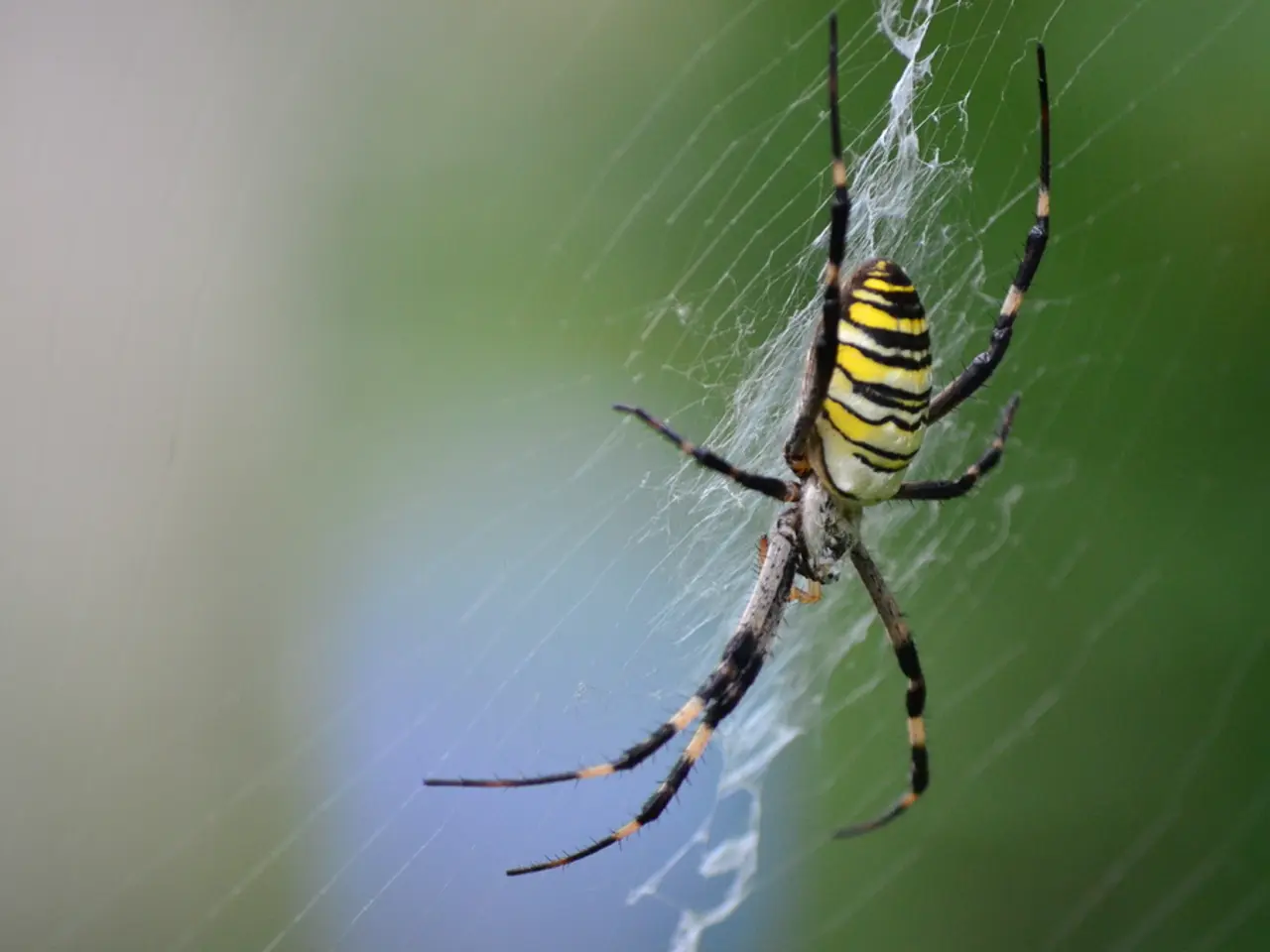
Experience the novel concept of sniffing with your limbs, a peculiar approach to sensing the world around you.
In a groundbreaking study, scientists from Greifswald University and Lund University have solved the mystery surrounding the sensory organs used by male spiders to detect scent cues emitted by females. The research, published in the journal PLOS ONE, reveals that the scent-detecting sensory organs, known as sensilla basiconica, are found not only on the legs of adult male spiders but also on their pedipalps.
Until now, the sensory organs involved in male spiders' scent detection were unknown. The study, led by Mohammad Belal Talukder and Carsten H. G. Müller from Greifswald University, aimed to shed light on this aspect, emphasising the importance of understanding the sensory systems of spiders, as they could potentially be used in the development of new technologies and sensors.
The sensilla basiconica contain sensory receptors that are sensitive to specific chemicals, allowing male spiders to detect the scent cues emitted by females. These scent-detecting sensory organs are hidden beneath tactile bristles and hairs on the legs of adult male spiders, a concealment that adds to the intrigue of these creatures.
The study was conducted on a variety of spider species, including those from the families Salticidae, Lycosidae, and Gnaphosidae. Interestingly, the number and distribution of these sensilla basiconica vary between different spider species. In some species, the sensilla basiconica are concentrated on the tibia and metatarsus of the legs, while in others, they are more evenly distributed across the legs and pedipalps.
The findings of this study could help in understanding the evolution of sensory systems in spiders and other arthropods. Moreover, the study suggests that male spiders may use a combination of tactile and chemical cues to find females, not just chemical cues as previously thought. This could open up new avenues for research in the field of arthropod behaviour and sensory perception.
The scent cues emitted by female spiders are essential for male spiders to find a mate. This discovery could lead to a better understanding of the mating behaviours and ecology of spiders, contributing to conservation efforts for these fascinating creatures.
Collaboration for this study was done with colleagues from Lund University. The researchers used a technique called scanning electron microscopy to visualise the sensilla basiconica and confirm their presence in male spiders. The investigation, which was carried out on multiple species of spiders, including the cribellate spiders where these scent-detecting sensory organs were previously unknown, has significantly advanced our knowledge of spider biology.
Read also:
- Chiropractic Manipulations and their Impact on Pain Relief
- Researchers Unearth Remarkable Creature Capable of Parturition of Two Distinct Species
- Honoring Ayurveda Day 2024: Tapping into the Power of AYUSH for Worldwide Wellbeing
- casesof West Nile virus resulting in fatalities in Greece, with seven individuals confirmed to have succumbed to the disease