Innovative Underwater Microscope Unveiled, Showcasing Incredible Clarity in Coral Detail
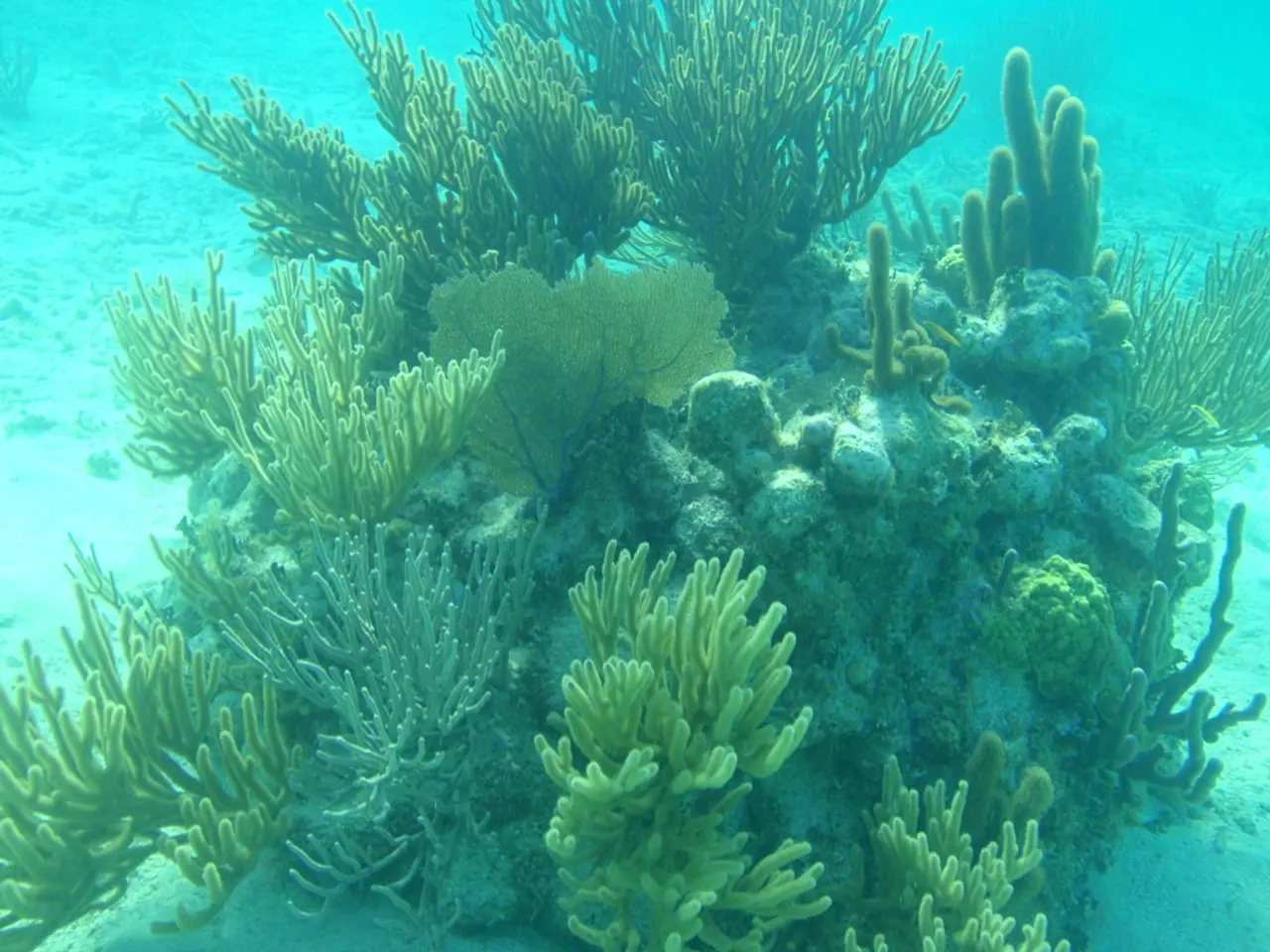
In a groundbreaking development for marine biology, a new microscope named Benthic Underwater Microscope Imaging PAM (BUMP) is providing researchers with high-resolution, in situ observations of coral physiology and the photosynthetic performance of symbiotic microalgae. This technological leap is set to significantly advance our understanding of coral health and the mechanisms behind coral bleaching.
The lead author of a study on this innovative microscope is Or Ben-Zvi, a postdoctoral researcher at Scripps Oceanography. Ben-Zvi and his team are particularly excited about the potential for learning more about corals and their behaviours under specific conditions with the BUMP microscope.
One of the key features of the BUMP microscope is its use of Pulse Amplitude Modulated (PAM) light techniques. This method pulses light at specific intensities and frequencies, then measures the resulting fluorescence from photosynthetic pigments, primarily chlorophyll in symbiotic algae. This allows scientists to visualise and quantify photosynthetic efficiency directly within coral tissues in real time.
The microscope also produces detailed 3D scans of coral tissue, distinguishing between fluorescence from chlorophyll (bright red) indicating photosynthetic activity, and cyan/green fluorescence from the coral’s fluorescent proteins, which relate to coral health and environmental conditions. This detailed fluorescence mapping offers insights into how well the algae are performing their essential role in the symbiosis, and how the coral is responding physiologically.
Unlike previous methods, BUMP is diver-operated and can be used directly on coral reefs without harming the organisms. This capability is crucial for understanding the mechanisms behind coral bleaching — the loss of symbiotic algae typically due to stress like rising temperatures. By visualising photosynthesis with unprecedented detail, researchers can observe how individual algae respond under stress, helping to pinpoint the early warnings and progression of bleaching events.
While current use focuses on coral ecosystems, the BUMP’s underlying technology has broad applicability to other underwater and benthic environments where photosynthesis and fluorescence can be studied. This includes seagrasses, algae beds, and microbial mats, where photosynthesis plays a crucial ecological role. The ability to non-invasively assess photosynthetic efficiency and health biomarkers could also be extended to assess the impacts of pollution, light pollution, or ocean acidification on various benthic communities.
The Jaffe Lab, which developed the microscope, sees a host of other potential applications, including off the coast of San Diego. The use of BUMP is significant as coral reefs are rapidly declining due to coral bleaching, and this microscope offers a promising tool for finding early warning signs for potential bleaching events and determining the health of corals and the causes of coral bleaching.
The paper detailing the development and applications of the BUMP microscope has been published in Methods in Ecology and Evolution. The team behind the microscope expresses excitement about the potential for learning more about corals and their behaviours under specific conditions with the microscope, and they look forward to further exploring its applications in the future.
- The advancement in marine biology, embodied by the Benthic Underwater Microscope Imaging PAM (BUMP), is set to revolutionize the understanding of coral health and coral bleaching mechanisms, aided by research conducted by postdoctoral researcher Or Ben-Zvi at Scripps Oceanography.
- The innovative microscope, BUMP, utilizes Pulse Amplitude Modulated (PAM) light techniques to visualize and quantify photosynthetic efficiency within coral tissues, providing real-time insights into the symbiosis between corals and symbiotic microalgae.
- The BUMP microscope also produces detailed 3D scans of coral tissue, allowing scientists to distinguish between photosynthetic activity and coral health indicators like fluorescent proteins, thereby offering valuable insights into the symbiosis and the coral's response to environmental conditions.
- The diver-operated BUMP microscope can be used directly on coral reefs without causing harm, facilitating the study of the mechanisms behind coral bleaching caused by stress factors such as rising temperatures.
- The groundbreaking potential of the BUMP microscope is not limited to coral ecosystems; its underlying technology can be applied to other underwater and benthic environments like seagrasses, algae beds, and microbial mats, with the ability to assess photosynthetic efficiency and health biomarkers in response to pollution, light pollution, or ocean acidification.